
From Rishis to Modern Times: The Journey of the Gotra System
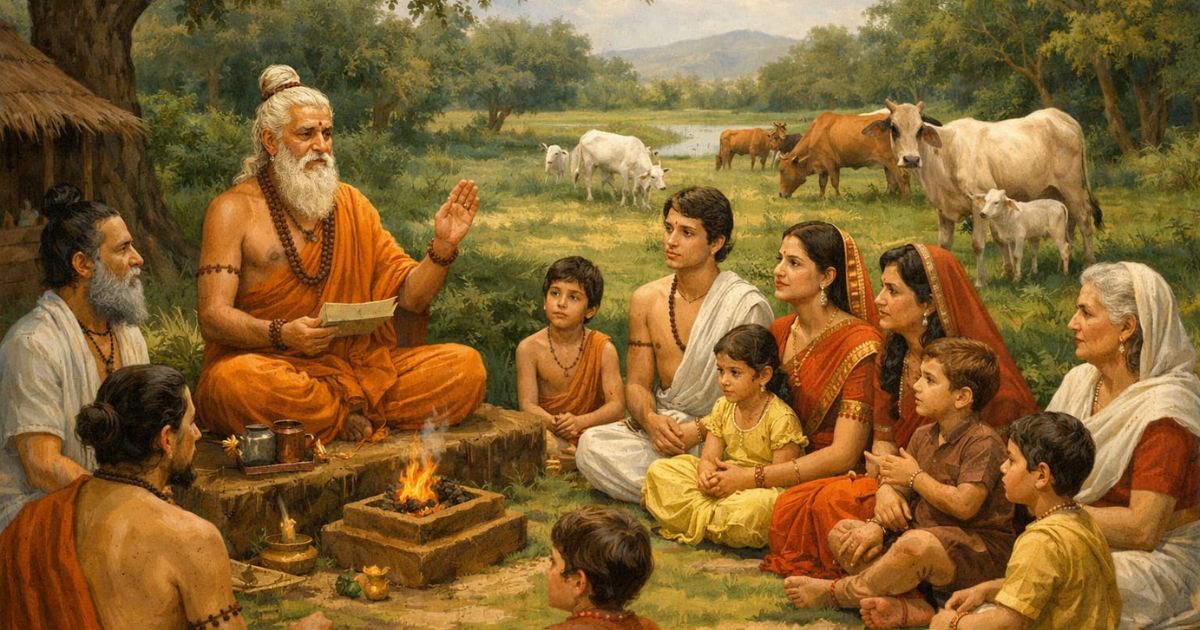
The concept of Gotra is one of the most ancient and foundational social institutions of Indian civilisation. The word Gotra comes from Sanskrit — “गो” (go) meaning cow and “त्र” (tra) meaning protection or shelter. Originally, it implied a group of cows protected within an enclosure. Over time, the term evolved to denote a lineage or clan tracing descent from a common male ancestor, usually a Vedic Rishi.
The Gotra system finds its roots in the Vedic period (around 1500–600 BCE). During this time, society was organized around families and gurukuls, where knowledge was transmitted orally from teacher to student. Lineage was carefully preserved because spiritual knowledge, rituals, and sacred duties were passed down within families.
Many Gotras trace their origin to the Saptarishis (Seven Great Sages) mentioned in Vedic literature:
i) Vashistha
ii) Vishwamitra
iii) Atri
iv) Bharadwaja
v) Gautama
vi) Jamadagni
vii) Kashyapa
These sages were not merely individuals but founders of intellectual and spiritual lineages. A Gotra signifies that a person is believed to be a descendant — biological or spiritual — of one of these Rishis.
The Gotra system originally served three purposes:
1. Preservation of lineage purity
2. Identification of ancestry
3. Prevention of close-kin marriages
It is important to understand that Gotra was primarily a biological and genealogical classification, not a social hierarchy.
Difference Between Gotra and Caste:
A common misconception is that Gotra and caste are the same. In reality, they are completely different systems with different origins and purposes.
Gotra:
- Based on lineage and ancestry
- Traces descent from a Vedic Rishi
- Exists across multiple communities
- Functions mainly in marriage rules
- Genealogical identity
Caste (Jāti):
- Based historically on occupation
- Local and regional grouping
- Social organization system
- Professional identity
The ancient Vedic social classification known as Varna was described in the Rigveda and later elaborated in the Manusmriti. The Varna system categorized society into Brahmin (knowledge), Kshatriya (protection), Vaishya (commerce), and Shudra (service). However, this was a functional division, not a rigid birth-based caste system as seen later.
Gotra predates rigid caste structures. A single Gotra like Kashyapa or Bharadwaja may be found among Brahmins, Kshatriyas, Vaishyas, and even some artisan communities.
Thus:
- Gotra = Lineage
- Caste = Occupation-based social grouping
Conflating the two creates historical misunderstanding.
Marriage Restrictions Between Same Gotra and Scientific Reason:
One of the most significant social functions of Gotra is in marriage regulation. Traditionally, marriage within the same Gotra is discouraged or prohibited, particularly in many North Indian communities.
Traditional Reason
Since members of the same Gotra are believed to descend from a common ancestor, they are considered siblings in a broader sense. Marriage between them is regarded as equivalent to marrying within the same bloodline.
Scientific Explanation
Modern genetics supports the logic behind this ancient rule:
i) Marrying within a close genetic pool increases the probability of recessive genetic disorders.
ii) Genetic diversity strengthens immunity and reduces inherited disease risk.
iii) Inbreeding may increase congenital abnormalities.
The Gotra rule functioned as a primitive but effective genetic safeguard, especially in ancient times when population clusters were small.
However, it is important to note that:
i) The scientific validity depends on actual biological relation.
ii) In many cases today, people sharing a Gotra may not be genetically related for thousands of years.
Thus, the rule was originally a social mechanism for exogamy (marrying outside one’s lineage) to ensure genetic diversity.
Existence of Same Gotra Across Different Castes in India:
A fascinating feature of Indian society is that the same Gotra exists across multiple castes and regions.
For example:
i) Kashyapa Gotra exists among Brahmins, Rajputs, and other communities.
ii) Bharadwaja Gotra appears in various regions including South and North India.
iii) Gautama Gotra is found in different linguistic groups.
This proves that Gotra was never limited to a single caste. In fact:
i) A Brahmin and a Kshatriya may share the same Gotra.
ii) Communities separated by geography still preserve identical Gotras.
iii) Some tribal communities also maintain clan systems resembling Gotra.
This demonstrates that Gotra is an ancestral identifier transcending social categories. Historically, mobility between professions was possible. Over centuries, occupation-based groups became rigid and evolved into caste structures. But Gotra continued as a lineage marker.
Caste as Professional Identity, Not Birth Identity:
Ancient Indian texts suggest that Varna was originally determined by qualities (guna) and actions (karma), not birth.
In the Bhagavad Gita, Chapter 4, Verse 13, Lord Krishna says:
“Chaturvarnyam Maya srishtam,
guna karma vibhagashah”
The fourfold order was created based on qualities and actions.
This indicates that caste was originally function-based, not birth-based. Examples from Indian tradition show flexibility:
i) Sage Vishwamitra was born a Kshatriya but became a Brahmarishi.
ii) Many royal sages engaged in spiritual teaching.
iii) Artisan families produced scholars.
Over time, due to political, economic, and social factors, caste became hereditary and rigid. But classical texts and early history show greater fluidity.
Thus:
- Gotra = Birth-based lineage
- Varna = Functional classification
- Jāti (caste) = Later social-professional grouping
Understanding this distinction is essential to avoid misinterpretation of Indian culture.
Conclusion:
The Gotra system is a profound and ancient institution rooted in Vedic civilization. It originated as a lineage-based structure tracing descent from revered Rishis. Its primary purposes were:
i) Preservation of ancestry
ii) Regulation of marriage
iii) Maintenance of social harmony
Gotra is fundamentally different from caste. While Gotra is genealogical, caste evolved as an occupational and later social classification.
The prohibition of same-Gotra marriage had strong biological reasoning aligned with modern genetics. The existence of identical Gotras across different castes further demonstrates that Gotra transcends social hierarchies.
Indian civilization originally emphasized guna (qualities) and karma (actions) over birth identity. The rigid caste system seen in later centuries was a socio-historical development, not necessarily the original spiritual vision.
Globally, clan systems similar to Gotra have existed in many cultures, reinforcing the universality of lineage-based identity. In understanding Gotra properly, we rediscover an aspect of Indian culture that was Scientific in intention, Spiritual in foundation, Socially stabilizing & Genealogically organized