
Sanatan: Most Misunderstood Word
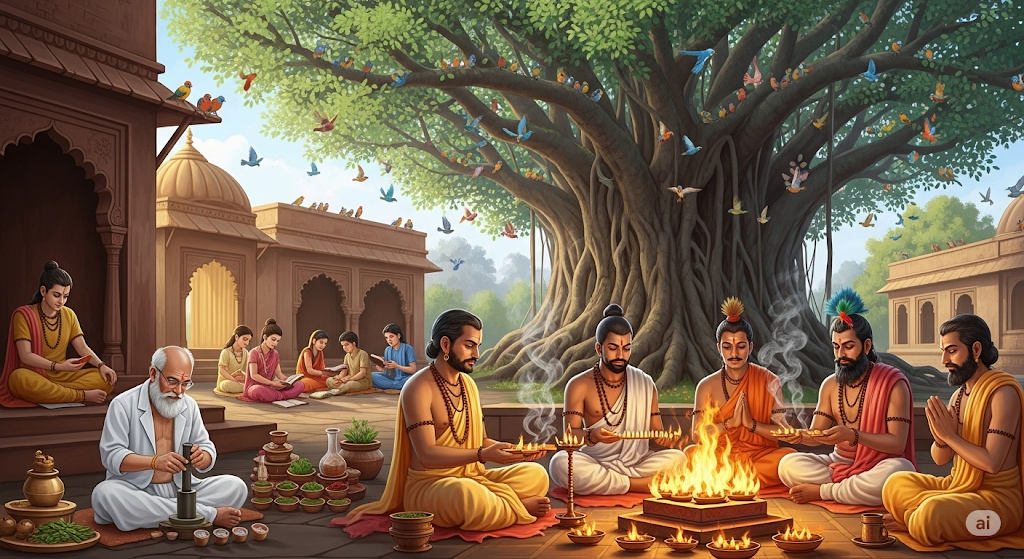
Among the many words inherited from the ancient wisdom of humanity, Sanatan is perhaps one of the most deeply misunderstood. It is often narrowly equated with a particular religion, community, or ritual practice. In popular discourse, it is sometimes portrayed as rigid, archaic, or bound to idol worship alone. Yet, when examined carefully, historically, philosophically, and experientially—the word Sanatan reveals a meaning far more universal, profound, and inclusive than commonly assumed. To understand Sanatan correctly is not merely an academic exercise; it is an inquiry into the roots of human civilization, moral consciousness, and the eternal search for truth and happiness.
The Meaning of Sanatan: Eternal and Timeless:
The word Sanatan comes from Sanskrit and literally means eternal, timeless, ever-existing,or that which has no beginning and no end. It does not refer to a historical event, a founder, or a fixed time period. Instead, it points to principles that remain true regardless of time, place, or culture.
When something is called Sanatan, it implies that it is not created by human authority, political power, or institutional decree. Rather, it is discovered through human experience, reflection, and realization. Truthfulness, compassion, non-violence, harmony with nature, and the pursuit of inner peace are examples of such eternal principles. They were relevant thousands of years ago, remain relevant today, and will continue to be relevant in the future. Thus, Sanatan is not about when something began, but about whether it endures.
Early Human Society and the Birth of Social Rules:
In the earliest days of human civilization, long before written scriptures or organized religions existed, human beings lived in small groups. Survival depended on cooperation—hunting together, sharing resources, protecting one another, and resolving conflicts peacefully.
Through lived experience, humans began to understand what caused disputes and suffering: greed, dishonesty, violence, and lack of mutual respect. To avoid chaos and ensure harmony, simple rules emerged organically. These rules were not written in books nor imposed by divine commandments. They were the result of collective discussion, observation, and trial-and-error. Rules such as sharing food, respecting elders, protecting children, and not harming members of one’s own group arose naturally. These early moral frameworks were humanity’s first expressions of dharma—right conduct that sustains social order.
At this stage, Sanatan was not a religion. It was a way of living based on shared experience and the desire for peaceful coexistence.
Fear of Nature and the Rise of Polytheism:
Early humans were deeply influenced by nature. Day and night, rain and drought, thunderstorms, earthquakes, disease, old age, and death were all mysterious forces beyond human control. Without scientific explanations, these phenomena appeared supernatural and overwhelming. To cope with fear and uncertainty, humans began personifying natural forces. The sun that gave warmth, the rain that nurtured crops, and the thunder that destroyed villages were imagined as conscious powers. This psychological response gave rise to gods and goddesses associated with different aspects of nature.
Thus began polytheism—the belief in many divine forces. Each god represented a particular power, emotion, or natural phenomenon. Worship was not philosophical abstraction; it was a survival instinct mixed with gratitude, fear, and hope. This stage of human belief was not “wrong” or “primitive.” It was a natural step in humanity’s evolving understanding of existence.
Ancestor Worship and the Origins of Idol Worship:
Another important development in early societies was the worship of ancestors. Death was deeply mysterious. People noticed that the deceased continued to live in memory, dreams, and emotional bonds. Gradually, it was believed that ancestors existed in another realm and could bless or protect their families.
Graves were marked with stones. Over time, these stones became symbolic representations of the departed. Large stones placed over burial sites eventually evolved into early forms of idols. Worship of ancestors slowly blended with worship of natural forces. Thus, idol worship did not originate from philosophical doctrines. It arose from emotional connection, remembrance, gratitude, and the human need to relate to the unseen through visible symbols. In this sense, idol worship is symbolic rather, than literal. It represents ideas, memories values, and forces that are otherwise intangible.
Agriculture, Leisure, and the Birth of Philosophy:
The invention of agriculture marked a turning point in human history. Stable food supplies led to settled societies. With survival needs relatively secured, humans gained leisure time—time to think, reflect, and question deeper aspects of life.
This period saw the rise of trade, professions, and economic differences. While prosperity increased, so did competition, jealousy, and mental distress. Humans began asking deeper questions:
Why do sorrow and happiness exist?
Is happiness permanent?
Is wealth the ultimate goal?
What is the purpose of life?
Some individuals withdrew from society to seek answers in solitude—forests, mountains, and riverbanks. Through meditation and deep contemplation, insights emerged about the nature of reality, consciousness, and self. These insights were later articulated as the Vedas. Importantly, the Vedas were not written as commandments imposed from above. They were revelations—realizations arising from intense inner exploration.
At this stage, dharma was understood primarily as right action: truthfulness, non-violence, self-discipline, and harmony with others and nature. These eternal values became known as Sanatan Dharma—the eternal duty or way of righteous living.
Are Polytheism and Idol Worship Sanatan?
A common question arises: if Sanatan means eternal, can polytheism and idol worship be considered Sanatan?
The answer is Yes, polytheism and idol worship are Sanatan in the sense that they have existed throughout most of human history. Across continents and cultures—India, Africa, the Americas, Europe, and Asia—humans have worshipped multiple gods, spirits, ancestors, symbols, sacred places, and natural elements.
Even today, what is called idol worship extends beyond statues. Reverence for holy books, sacred cities, relics, and symbols is also a form of symbolic worship. The object itself is not worshipped; what it represents is. In this sense, idol worship is a universal human practice, not exclusive to any one religion.
Monotheism, Numbers, and the Question of the “Real God”:
Monotheism—belief in one God—also emerged at a certain stage of human intellectual evolution. Christianity arose in a region where polytheism was prevalent. Islam emerged in Arabia, where multiple gods were worshipped. Today, Christianity has around 2.5 billion followers, Islam about 2 billion, and Hinduism about 1.15 billion. But can numerical majority decide whose God is real?
If truth were decided by numbers, history would constantly rewrite divinity. Moreover, many tribes across the world still worship local deities unknown to major religions. What if one such local deity turned out to be “real”? Would global religions accept that possibility?
No human being can claim absolute knowledge of God. In such uncertainty, imposing exclusivity becomes problematic. This is where Hindu thought stands apart. It accommodates monotheism and polytheism simultaneously. One may worship one God, many gods, or the formless absolute—all are accepted as valid paths.
Sanatan, Hinduism, and the Universal Principle:
Is Hinduism is Sanatan Dharma, or is Sanatan something beyond Hinduism? The answer is simple. Every religion contains elements of Sanatan, but Sanatan is not confined to any religion. Wherever there is truthfulness, non-violence, compassion, respect for all living beings, and reverence for nature, Sanatan exists. These values are found in all major religions.
This idea is beautifully expressed in the Bhagavad Gita, Chapter 9, Verse 4:
Mayā tatam idaṁ sarvaṁ jagad avyakta-mūrtinā |
mat-sthāni sarva-bhūtāni na chāhaṁ teṣhvavasthitaḥ ||
Meaning:
“By Me, in My unmanifested form, this entire universe is pervaded. All beings are in Me, but I am not in them.”
This verse reflects the Sanatan vision: an all-pervading reality that transcends form, name, and doctrine.
Conclusion: Sanatan Is Larger Than Any Religion
Sanatan Dharma is not a competing religion. It is the eternal foundation upon which all dharmic principles stand. Religions may arise, evolve, divide, and transform—but Sanatan remains. Sanatan teaches us how to live rightly, not what label to wear. It is present wherever there is ethical living, inner inquiry, and harmony with existence.Thus, Sanatan Dharma is present in all dharmas, but all dharmas are not present in Sanatan Dharma. Sanatan is the ocean; religions are rivers flowing into it. To understand Sanatan is to move beyond misunderstanding—and toward timeless wisdom.
hi
it is free of cost?